

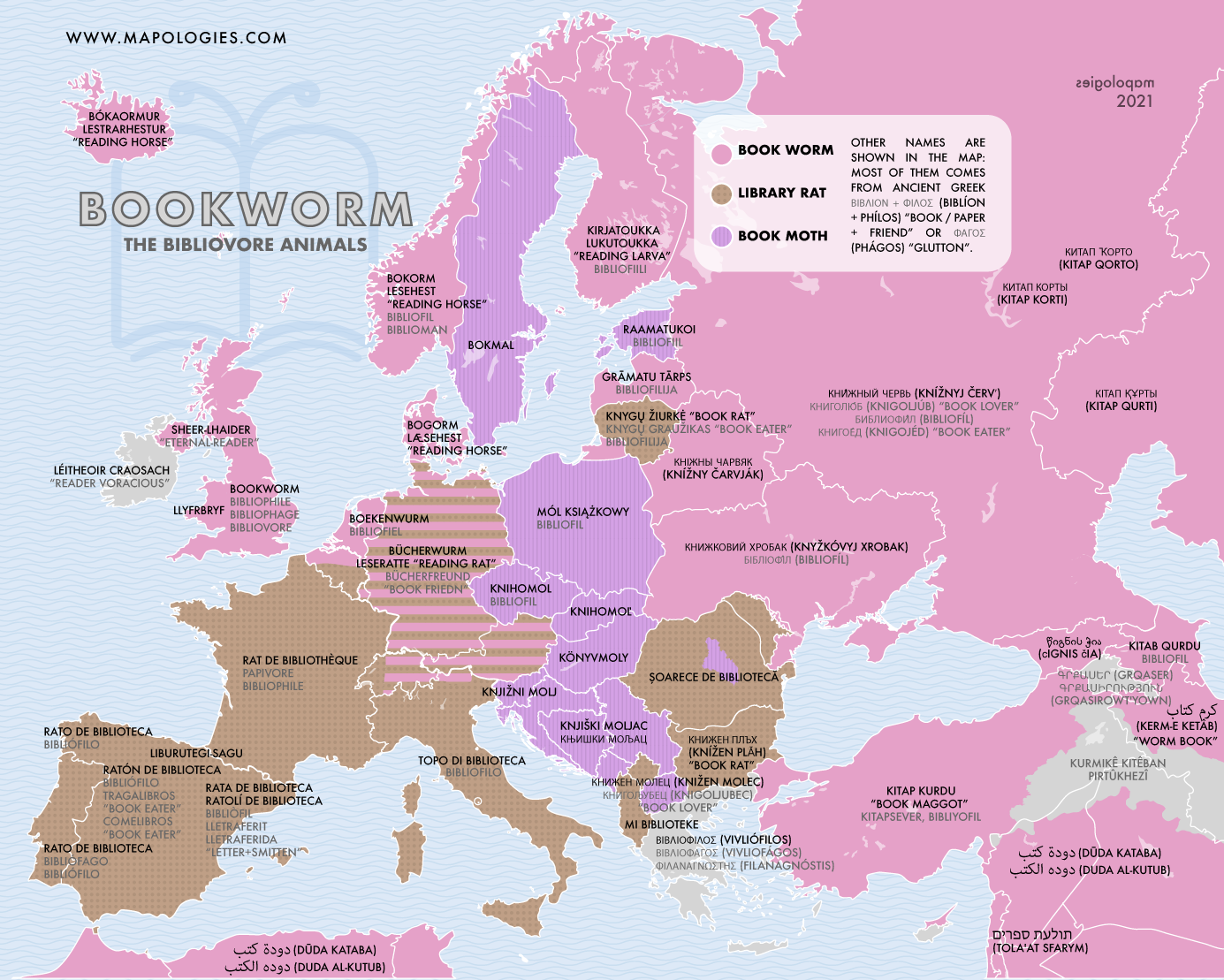
The infographic from Mapologies shows how bookworms are called in almost any language spoken in Europe.
Book lovers are found all over the world, and each culture has its own unique way to describe them.
Whether you call yourself a bibliophile, bookworm, booknerd, book dragon or library mouse, the most important thing is that you enjoy reading books. And it doesn’t really matter which language you speak.
From Mapologies comes an interesting map that shows how book lovers are being described in different countries across Europe.
The word “bookworm” is most commonly used, and adopted by different languages with minor or major modifications.
The word “bibliophile” – although not as popular as “bookworm” – is present in almost any language. It comes from the Greek words “biblion” (book) and “philos” (lover).
The word “bookworm” is thought to have originated in the 16th century, and is a reference to the larvae of certain insects, such as beetles and moths, which can damage books.
The first recorded use of the word “bookworm” referring to a person was in 1580, in a correspondence between the English poet Edmund Spenser and his friend Gabriel Harvey. It is confirmed by the Oxford English Dictionary (OED).
In French, the word for “bookworm” is “rat de bibliothèque” (library rat). In German, it’s “Bücherwurm” (bookworm). In Italy, the most common way to describe a book lover is “topo di biblioteca,” which is a library mouse. The same in Spain – “ratón de biblioteca” is nothing else but a library mouse.
On the other hand, Norwegians prefer to use other references than insects and rats. In Norway, you will be called “bokorm lesehest,” which stands for “reading horse”.
It’s worth noting – and that’s not a part of the infographic – that Scandinavians prefer to say “booknerd” than “bookworm”. In Swedish, it’s “boknörd,” in Danish – “bognørd,” and in Norwegian – “boknørd”.
Back to the infographic. Countries that use a reference to a worm are marked in pink. The ones that refer to moths are shown in purple. If the country is marked in brown, it implies that a reference to mouse or rat is the most popular.
Fun fact 1. In Greece, they don’t use other words than their own, classic “bibliophile”.
Fun fact 2. In Irish, there is a term “léitheoir craosach” to describe a book lover. Google Translate returns the English “voracious reader,” which is also shown on the infographic. However, the English-Irish dictionary has the direct translation to “bookworm”.
Click on the infographic to see it enlarged.
Source: Bookworms – Mapologies
 Reader Updated